Events
"Let's Look Inside UT's Labs!" is an annual event that has been held since 2012, during which high school students from all over Japan and the world get a glimpse of what it's like inside the University of Tokyo. This year, our Igata Lab is joining this program! Wouldn't you like to take a look at the researchers and students who tackle the (currently very topical) issue of Economic Security in their natural habitats?
Nowadays, some states are not only increasing their military power but also refining their tactics through economic and informational policies in response to geopolitical tensions. It is becoming increasingly important to secure supply chains of semiconductors, AI and biotechnologies and increase their global competitiveness. Furthermore, gathering intelligence despite the potential for disinformation and influence operations by generative AI is also of importance. In this event, we will host a lecture covering the fundamentals of economic security and an analysis of some states' recent behaviours. We will also showcase student activities and conclude the sessions with an all inclusive Q&A and discussion.
We will host two in-person sessions on March 26 and two on-line sessions on March 27.
(*Please note that all four sessions will be the same content.)
On March 26 (Thursday), students will have the opportunity to visit the Research Center for Advanced Science and Technology in Komaba Campus II, and directly talk to Project Lecturer Igata and a few members of the Economic Security Intelligence lab.
On March 27 (Friday), as the entire program will be carried out online, students living far away will also have a chance to join.
We look forward to receiving your active participation!
-
Date
[In-person] March 26, 2026 (Thursday): (1) 10:15~11:15、(2) 13:15~14:15
[Online] March 27, 2026 (Friday): (1) 13:40~14:40、(2) 14:50-15:50 -
Place
March 26, 2026 (Thursday): Komaba II Campus
March 27, 2026 (Friday): Online - Fee Free of charge (Participants are responsible for their own travel, accommodation, and other expenses.)
- Speakers Akira Igata (Project Lecturer, RCAST, The University of Tokyo) and other members of the lab
- Language Mainly Japanese
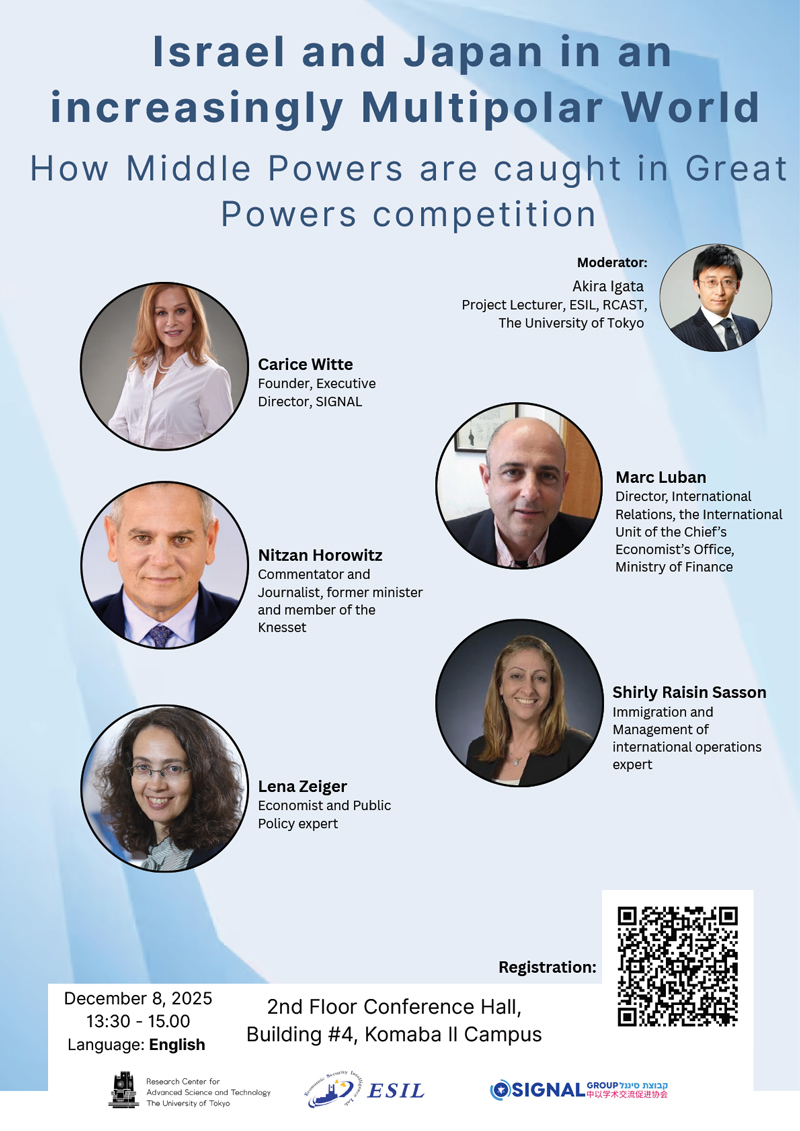
The Economic Security Intelligence Lab (ESIL) at the Research Center for Advanced Science and Technology (RCAST), The University of Tokyo, is pleased to host a public seminar featuring a delegation from the Israel-based think tank SIGNAL Group titled:
Israel and Japan in an increasingly Multipolar World:
How Middle Powers are caught in Great Powers competition
Great Powers competition between the U.S. and China continues to fragilize an already fragmented world. Since the Covid-19 crisis, numerous challenges have tested the foundation of the post-Cold War global order, and middle powers are faced with a difficult choice between prioritizing traditional allies and sustaining the multilateral order. Israel and Japan stand as symbolic cases for this fragile equilibrium. Both countries are at the forefront of middle power struggle in a century of great power competition.
The delegation from SIGNAL is composed of various experts and policymakers who are confronted directly with this struggle. The think tank, which presents itself as the only think tank specializing in engagement with China, will bring the perspective of Israel on issues related to the Indo-Pacific security and the economic and political competition between the U.S. and China. Together with the Japanese perspective, they will discuss the future of multilateralism in an increasingly multipolar world.

The Economic Security Intelligence Lab (ESIL) at the Research Center for Advanced Science and Technology (RCAST), The University of Tokyo is honored to host Francesco Maria Talò, Special Envoy of the Government of Italy for the India–Middle East–Europe Economic Corridor (IMEC) for a public symposium.
H.E. Amb. Talò previously served as Diplomatic Advisor to Prime Minister Giorgia Meloni and is one of Italy’s most experienced senior diplomats, having held posts such as Italy’s Permanent Representative to NATO, Ambassador to Israel, and Special Envoy for Afghanistan and Pakistan. During the launch of the Meloni administration in 2022, he played a key role in shaping Italy’s foreign policy.
As Special Envoy, H.E. Amb. Talò is responsible for advancing IMEC, a strategic initiative connecting India, the Gulf region, and Europe through integrated infrastructure networks. The project aims to enhance connectivity through multi-modal transport links, green energy corridors, diversified and resilient supply chains, and expanded digital and logistics infrastructure. In an era of growing geopolitical uncertainty, IMEC is increasingly viewed as a critical framework for strengthening global economic security. He leads Italy’s efforts to operationalize the corridor, coordinating with partner governments, industry stakeholders, and international institutions across investment, transportation, and energy domains.
This symposium will explore the current status and future outlook of IMEC, the potential roles Italy may play in regional and global infrastructure initiatives, and opportunities for Japan-Italy cooperation. Discussions will be led by Akira Igata (Project Lecturer, RCAST, The University of Tokyo), with considerations of concrete areas of collaboration, including port and logistics development, energy transition, semiconductor and strategic-materials supply chain resilience, and broader engagement in the Indo-Pacific and Indo-Mediterranean regions.
This seminar will be conducted in English.

The Economic Security Intelligence Lab (ESIL) at the Research Center for Advanced Science and Technology (RCAST), The University of Tokyo, is pleased to host a public symposium featuring the former Defense Minister of Georgia Tinatin Khidasheli titled:
Frontlines of Influence:
Russia, China, and the Hybrid Contest over Georgia
In recent years, Georgia has stood at a geopolitical crossroads, caught between its aspirations for deeper integration with Europe and the expanding influence of authoritarian networks centered in Moscow and Beijing. Although a small country in the Caucasus, Georgia reflects many of the world’s most urgent strategic challenges: Russian elite capture encouraging democratic backsliding, China’s economic engagement creating new dependencies and opaque financial flows, and the rapid erosion of civic space that undermines civil society and opposition voices.
The symposium will feature a keynote address by Tinatin Khidasheli, former Georgian Minister of Defence and current head of the Georgian think tank Civic Idea. She will outline the current domestic situation and Russia’s role in shaping political dynamics inside Georgia. Her remarks will also explore how Georgia has become a test site for hybrid warfare, with clear parallels to gray zone tactics in the South China Sea and around Taiwan. Ms. Khidasheli will discuss the promised investments from China in Georgia such as the strategically critical port of Anaklia that faces the Black Seas, the regional connectivity logic shaping the Caucasus, and the potential role that Japan can play in countering China’s rise in countries facing similar pressures.
These issues are not limited to Georgia. Disinformation campaigns originating from authoritarian actors have had international consequences, including direct implications for Japan. As civic space has contracted within Georgia, Ms. Khidasheli has herself become a target of mass disinformation. One prominent example is an absurd television “documentary” that falsely portrayed her as a “Taiwanese agent” and even claimed that the Japanese government bribed her to carry out its agenda.
Ms. Khidasheli will be joined by two leading experts. Dr. Aya Adachi of the German Council on Foreign Relations will contribute insights from her research on Chinese economic influence in Georgia. Maya Sobchuk of the Economic Security Intelligence Lab at the Research Center for Advanced Science and Technology, The University of Tokyo, will draw on her work on Russian influence operations in Georgia. Akira Igata will moderate the discussion and guide the conversation toward three core themes: the strategic resilience of small democratic states, the implications for European and Asian security theaters, and policy options for partners such as Japan.
The seminar will be conducted in English, and pre-registration is required to participate.

The Economic Security Intelligence Lab (ESIL) at The Research Center for Advanced Science and Technology (RCAST), The University of Tokyo together with the Japan Association for Cellular Agriculture (JACA), will co-host the International Conference on the Use of Cultured Cells in Food: Towards a Food-Bio-READY Society.
This conference will feature discussions on:
(1)Research findings on risk assessment methods for cultured meat produced using cell culture technology;
(2)International debates on the latest risk assessment policies for novel and cellular foods;
(3)Recent developments regarding the safety of culture media used in cellular foods;
(4)Recent developments regarding the safety of cells used in cellular foods.

The Economic Security Intelligence Lab (ESIL) at the Research Center for Advanced Science and Technology (RCAST), The University of Tokyo, is pleased to host a seminar featuring two of its visiting research students: Mr. Tim Ellemann, a PhD candidate at the European University Institute, and Mr. Tim Cichanowicz, a PhD candidate at the University of Kansas.
Session 1:
Mr. Ellemann will present his research titled “The Borders of Trade Law: Facilitating and Restricting Movement of Ideas Through Economic Security Instruments,” in which he examines economic security in Europe from the perspective of international trade law.
Session 2:
Mr. Cichanowicz will give a presentation titled “National Security or Protectionism? The Determinants of Which Traded Products Become Securitized,” discussing the criteria by which “critical goods” are designated for economic security purposes in the United States.
The seminar will also include a Q&A session focusing on preventing the misuse of AI, the sharing of data between public and private sectors, and perspectives on international cooperation in this area.

The Economic Security Intelligence Lab (ESIL) at the Research Center for Advanced Science and Technology (RCAST), The University of Tokyo, is pleased to co-host a public seminar with the Institute of Contemporary Asian Studies (ICAS) at Temple University, Japan Campus (TUJ) titled “Japan in the New Nuclear Age: In Search of Stability in an Uncertain World”
We will feature Ankit Panda, Stanton Senior Fellow at the Carnegie Endowment for International Peace in the Nuclear Policy Program.
Nuclear weapons are returning to the fore of international statecraft in ways unseen since the Cold War. With major powers like Russia issuing threats of nuclear strikes, China and North Korea continuing to grow their arsenals, and new prospects for proliferation from the Middle East to Europe to East Asia, the world has been thrust into a new era of heightened nuclear risk. Moreover, the prospect of nuclear escalation is again shaping how political decision-makers and military establishments around the world think and act. But unlike the peril of the Cold War, a greater number of nuclear players and a plethora of new technologies, including AI and exotic new weapons, make the search for stability far from straightforward. How much of this new nuclear age is really “new”? What are the ways in which states can work to mitigate the worst risks?
Panda will share these insights based on his latest book: The New Nuclear Age: At the Precipice of Armageddon (Polity, 2025).
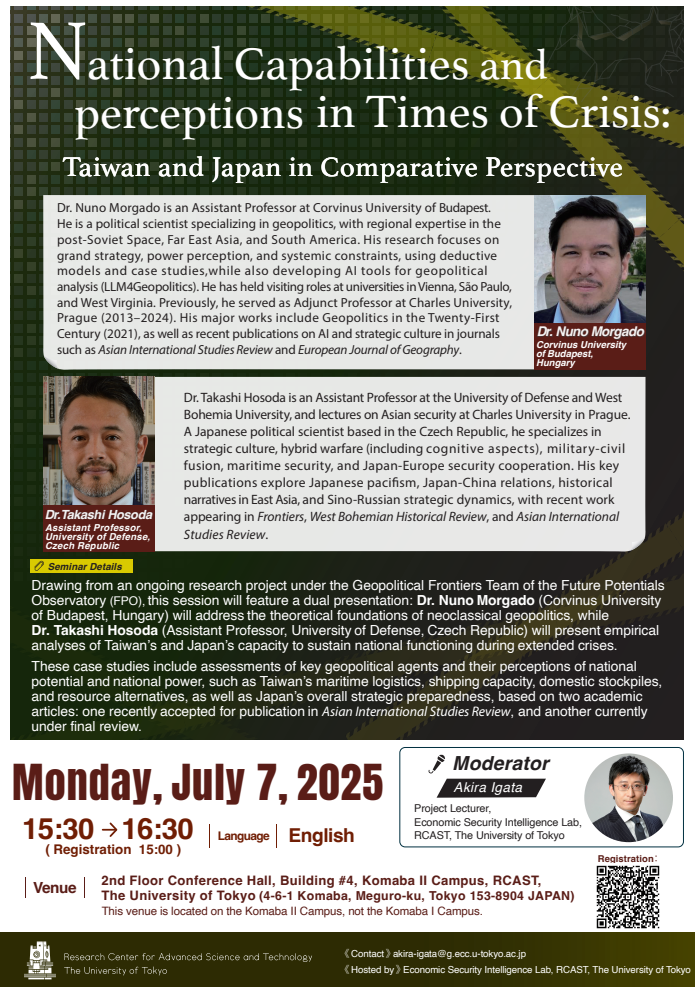
Drawing from a research initiative under the Geopolitical Frontiers Team of the Future Potentials Observatory (FPO), this seminar will feature a dual presentation on the intersection of national resilience and strategic perception in the Asia-Pacific.
Drawing from an ongoing research project under the Geopolitical Frontiers Team of the Future Potentials Observatory (FPO), this session will feature a dual presentation: Dr. Nuno Morgado (Corvinus University of Budapest, Hungary) will address the theoretical foundations of neoclassical geopolitics, while Dr. Takashi Hosoda (Assistant Professor, University of Defense, Czech Republic) will present empirical analyses of Taiwan’s and Japan’s capacity to sustain national functioning during extended crises.
These case studies include assessments of key geopolitical agents and their perceptions of national potential and national power, such as Taiwan’s maritime logistics, shipping capacity, domestic stockpiles, and resource alternatives, as well as Japan’s overall strategic preparedness, based on two academic articles: one recently published in Asian International Studies Review and another currently under final review.
Together, their presentations address the broader phenomenon of “geopolitical misrepresentation” (or geomisguidance) in contemporary security environments, exploring how material and non-material factors, including cognitive, institutional, and cultural variables, shape strategic decision-making amid uncertainty.

The Economic Security Intelligence Lab (ESIL) at the Research Center for Advanced Science and Technology (RCAST), The University of Tokyo, is pleased to host a seminar featuring Commander Dr. Jay Tristan Tarriela of the Philippine Coast Guard and Dr. Jeffrey Ordaniel, Associate Professor at Tokyo International University and a leading expert in this field.
The seminar will explore the Maritime Transparency Initiative, an effort by the Philippine Coast Guard to proactively communicate illegal and problematic activities occurring in the West Philippine Sea. The speakers will also discuss these activities from the perspective of international maritime law, along with analyses and insights on the current state of international cooperation in responding to such challenges.

The Economic Security Intelligence Lab (ESIL) at the Research Center for Advanced Science and Technology (RCAST), The University of Tokyo, is pleased to co-host a public seminar with the RAND Corporation, titled:
Japan-U.S.-ROK Trilateralism in Action:
Securing Critical Mineral Supply Chains for Economic Resilience
As strategic competition intensifies and economic coercion reshapes the global trade landscape, securing resilient supply chains for critical minerals has emerged as a top priority for policymakers and industry leaders alike. Japan, the United States, and the Republic of Korea - three leading Indo-Pacific democracies - are increasingly coordinating efforts to address vulnerabilities in both commercial and defense-related supply chains.
This public seminar brings together leading experts from the RAND Corporation to examine how Japan-U.S.-ROK trilateral cooperation can advance economic security and supply chain resilience under the Trump 2.0 administration.

On Tuesday, June 10, 2025, the Economic Security Intelligence Program (ESIL) at the University of Tokyo’s Research Center for Advanced Science and Technology (RCAST) hosted a special lecture by H.E. Alexander Stubb, President of the Republic of Finland. The event drew over 100 participants and proceeded in three parts: the President’s keynote speech, a dialogue with Dr. Akira Igata (Project Lecturer at RCAST / Director of ESIL), and an open Q&A session with the audience.
Multipolar disorder or multilateral order?
Public Lecture by H.E. Dr. Alexander Stubb, 13th President of the Republic of Finland
The world has changed more in the past three years than in the previous thirty years combined. The liberal world order, as we have known it since the end of World War II, is dying. Multilateral cooperation is giving way to multipolar competition and conflict. The search is on for a new world order, a rebalancing of power. The next decade will determine the world order for the rest of the century.
At this historical turning point, the Research Center for Advanced Science and Technology (RCAST) at The University of Tokyo is honored to host H.E. Dr. Alexander Stubb, the 13th President of the Republic of Finland, for a public symposium. The event will begin with opening remarks by President Teruo Fujii of the University of Tokyo and Director Masakazu Sugiyama of RCAST, followed by a keynote speech by President Stubb. The program will also include a dialogue with Project Lecturer Akira Igata and an open Q&A session with the audience. This symposium offers a rare opportunity to gain direct insight from a global leader engaged at the front lines of international affairs.
President Stubb holds a Ph.D. in International Relations from the London School of Economics and Political Science (LSE), one of the world’s leading institutions in political studies. He has served as a Member of the European Parliament and has held key positions in the Finnish government, including Minister for Foreign Affairs, Minister for European Affairs and Foreign Trade, Minister of Finance, and Prime Minister. In March 2024, he assumed office as President of Finland. In addition to his extensive policy experience, he has long been engaged in academic research and teaching in international politics, bridging theory and practice to address global challenges. Today, he continues to demonstrate leadership among European heads of state, drawing on both deep expertise and diplomatic experience.
Mailing List
The earliest information about the latest event will be delivered.
Please register from the button below.
If you have any requirements, please contact us using the contact form.