Events
"Let's Look Inside UT's Labs!" is an annual event that has been held since 2012, during which high school students from all over Japan and the world get a glimpse of what it's like inside the University of Tokyo. This year, our Igata Lab is joining this program! Wouldn't you like to take a look at the researchers and students who tackle the (currently very topical) issue of Economic Security in their natural habitats?
Nowadays, some states are not only increasing their military power but also refining their tactics through economic and informational policies in response to geopolitical tensions. It is becoming increasingly important to secure supply chains of semiconductors, AI and biotechnologies and increase their global competitiveness. Furthermore, gathering intelligence despite the potential for disinformation and influence operations by generative AI is also of importance. In this event, we will host a lecture covering the fundamentals of economic security and an analysis of some states' recent behaviours. We will also showcase student activities and conclude the sessions with an all inclusive Q&A and discussion.
We will host two in-person sessions on March 26 and two on-line sessions on March 27.
(*Please note that all four sessions will be the same content.)
On March 26 (Thursday), students will have the opportunity to visit the Research Center for Advanced Science and Technology in Komaba Campus II, and directly talk to Project Lecturer Igata and a few members of the Economic Security Intelligence lab.
On March 27 (Friday), as the entire program will be carried out online, students living far away will also have a chance to join.
We look forward to receiving your active participation!
-
Date
[In-person] March 26, 2026 (Thursday): (1) 10:15~11:15、(2) 13:15~14:15
[Online] March 27, 2026 (Friday): (1) 13:40~14:40、(2) 14:50-15:50 -
Place
March 26, 2026 (Thursday): Komaba II Campus
March 27, 2026 (Friday): Online - Fee Free of charge (Participants are responsible for their own travel, accommodation, and other expenses.)
- Speakers Akira Igata (Project Lecturer, RCAST, The University of Tokyo) and other members of the lab
- Language Mainly Japanese

"Let's Look Inside UT's Labs!" is an annual event that has been held since 2012, during which high school students from all over Japan and the world get a glimpse of what it's like inside the University of Tokyo. This year, our Igata Lab is joining this program! Wouldn't you like to take a look at the researchers and students who tackle the (currently very topical) issue of Economic Security in their natural habitats?
Nowadays, some states are not only increasing their military power but also refining their tactics through economic and informational policies in response to geopolitical tensions. It is becoming increasingly important to secure supply chains of semiconductors, AI and biotechnologies and increase their global competitiveness. Furthermore, gathering intelligence despite the potential for disinformation and influence operations by generative AI is also of importance. In this event, we will host a lecture covering the fundamentals of economic security and an analysis of some states' recent behaviours. We will also showcase student activities and conclude the sessions with an all inclusive Q&A and discussion.
We will host two in-person sessions on March 26 and two on-line sessions on March 27.
(*Please note that all four sessions will be the same content.)
On March 26 (Thursday), students will have the opportunity to visit the Research Center for Advanced Science and Technology in Komaba Campus II, and directly talk to Project Lecturer Igata and a few members of the Economic Security Intelligence lab.
On March 27 (Friday), as the entire program will be carried out online, students living far away will also have a chance to join.
We look forward to receiving your active participation!

*Please note that this event will be conducted in Japanese only.
The Economic Security Intelligence Lab (ESIL) at the Research Center for Advanced Science and Technology (RCAST), The University of Tokyo, will host the following public seminar, welcoming Dr. Shogo Akagawa, Visiting Lecturer at the Faculty of History and Cultural Studies, Free University of Berlin, and Europe-based Editorial Writer for The Nikkei.
East Germany’s Intelligence Operations Targeting Japan:
Political and Economic Elites, Information Warfare, and Lessons for Today Revealed through Declassified Documents
In this seminar, we will be joined by Dr. Shogo Akagawa, author of the newly published book Hidden Histories of the Cold War between Japan and Germany: Truths Revealed by East German Secret Documents (Keio University Press, October 2025). Drawing on an extensive body of declassified East German intelligence files and interviews with former government officials, the book offers the most comprehensive analysis to date of East Germany’s policy toward Japan and its covert operations during the Cold War. It sheds new light on how Japan was positioned as a strategic frontline state in the East–West confrontation and examines, through primary sources, the nature of contacts, approaches, and influence activities directed at Japanese actors.
The lecture will examine in detail how East Germany conducted its intelligence and influence operations toward Japan, including efforts to cultivate ties with political, business, and media elites, covert activities disguised as economic and commercial exchanges, and cases of industrial espionage such as illegal semiconductor technology transfers in violation of COCOM export controls. By tracing how Japan became entangled in information warfare and influence operations as a result of fundamental misperceptions about the nature of the Cold War, the seminar will also highlight the vulnerabilities in postwar Japan’s understanding of its international environment and external economic relations.
In addition, the seminar will explore what lessons these Cold War experiences offer for today’s international environment. Information warfare, industrial espionage, disinformation, influence operations, and competition over science and technology have reemerged, in transformed forms, as central challenges in contemporary international politics and economic security. Using historical cases as a point of reference, the seminar will provide an opportunity for participants to reflect, through discussion, on the risks of today’s information environment and how best to confront them.

The Economic Security Intelligence Lab (ESIL) at the Research Center for Advanced Science and Technology (RCAST), The University of Tokyo, and the Embassy of Iceland in Tokyo is honored to co-host for a public symposium titled:
[Symposium featuring the Foreign Minister of Iceland]
Japan–Iceland Cooperation on Economic Security:
Bridging the Arctic and the Indo-Pacific
At this symposium, we are honored to welcome H.E. Þorgerður Katrín Gunnarsdóttir, Minister for Foreign Affairs of Iceland, to discuss the future potential of Japan–Iceland relations, primarily from the perspective of economic security. Minister Gunnarsdóttir has previously served as Minister of Education, Science and Culture; Minister of Fisheries and Agriculture; and Acting Prime Minister. Drawing on her broad policy experience and strategic insight, the symposium will explore new possibilities for Japan–Iceland cooperation with a view toward both the Arctic and the Indo-Pacific.
Japan and Iceland share fundamental values such as democracy and the rule of law. Building on this foundation, the two countries have deepened cooperation across a wide range of areas, including the maintenance of the free trade system, the stable supply of strategic goods, and energy collaboration leveraging advanced technologies.
In particular, in the Arctic, Japan has become an important partner for Iceland through scientific cooperation and environmental protection efforts within the framework of the Arctic Council. The reduction of sea ice due to climate change is increasing the potential use of Arctic sea routes, while also expanding the scope of fisheries and other economic activities. These developments have heightened international attention to resource management and monitoring frameworks, and have made institutional responses to ensure marine environmental protection and the sustainability of biological resources ever more critical. As a result, discussions surrounding the Arctic now intersect not only with environmental cooperation but also with broader questions of regional security and the future of international order.
Moreover, the Arctic region and its surrounding areas are rapidly gaining importance from the perspective of economic security. Undersea infrastructure, including undersea cables, forms a critical foundation for global economic activity and information networks. Ensuring their protection and stable operation is directly linked to the resilience of supply chains and data flows. At the same time, growing attention is being directed toward the Arctic’s mineral and rare resource reserves. These materials are indispensable for advanced technologies and clean energy industries. As supply chain risks associated with economic coercion by states become increasingly apparent, the importance of diversifying and securing stable sources of supply has been widely emphasized at the international level. In addition, cooperation in geothermal and other clean energy sectors offers a promising model for leveraging the strengths of both countries, demonstrating how sustainability and economic security can be mutually reinforcing.
This symposium will examine, from the perspective of linking the Arctic and the Indo-Pacific as two strategic spaces, how cooperation among value-sharing partners can contribute to regional stability and economic resilience. In an era of accelerating geopolitical change, it will provide an opportunity for multifaceted discussion on the role that Japan–Iceland relations can play in shaping a stable and sustainable international order.
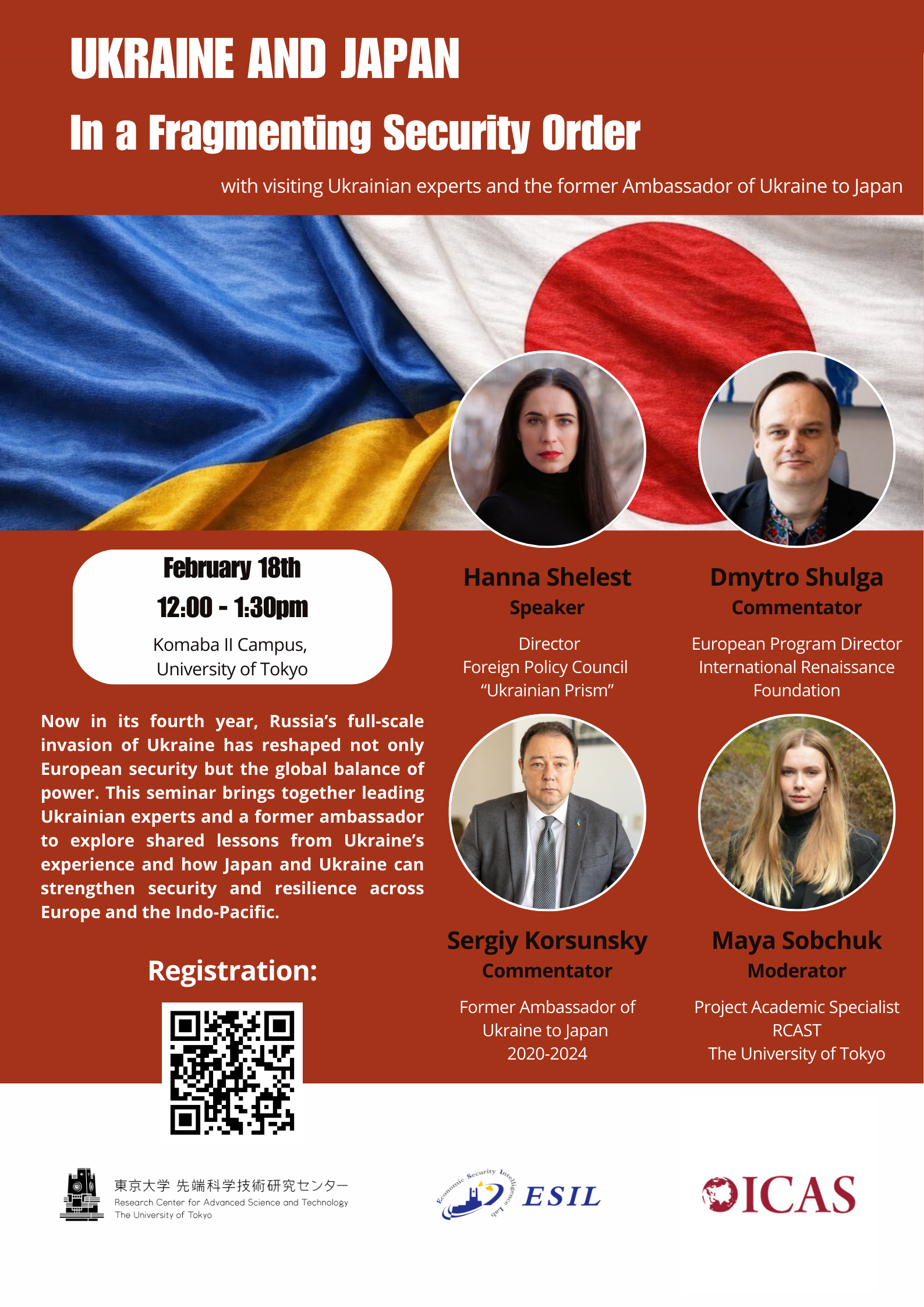
The Economic Security Intelligence Lab (ESIL) at the Research Center for Advanced Science and Technology (RCAST), The University of Tokyo, is pleased to co-host a brown bag lunch seminar (please feel free to bring your own lunch) with the Institute of Contemporary Asian Studies (ICAS), Temple University Japan titled:
Ukraine and Japan in a Fragmenting Security Order:
with Visiting Ukrainian experts and the former Ambassador of Ukraine to Japan
Russia’s full-scale invasion of Ukraine, which began in February 2022, reached its fourth year in February 2026. This invasion remains an ongoing, protracted conflict that raises fundamental questions not only about European security, but also about the international legal order and the global balance of power. The war has laid bare both cooperation and division among major powers, and countries in Asia—including Japan—are being challenged to determine how they should respond. While the Japanese government has demonstrated solidarity with Ukraine through diplomatic and material support, it is also being compelled to reassess its strategic approach within a changing international order.
For Japan, the invasion of Ukraine has spurred a dramatic recalculation of its defense posture and its place in the world. Asian democracies quickly began to view Ukraine not as a distant case, but as a relevant security mirror. Particularly as traditional security guarantors such as the United States recalibrate their global role, Japan is being called upon to assume greater responsibility on the world stage. These debates intersect with broader concerns relevant to Japan and other partners, including energy security, economic resilience, supply-chain dependencies, and challenges to the rule-based international order. Ukraine’s experience—both in resisting military aggression and in adapting its security, technological, and information strategies—offers valuable lessons for democracies facing persistent hybrid threats across Europe and the Indo-Pacific.
This seminar will welcome leading Ukrainian experts and a former ambassador to examine these issues from multiple perspectives. The discussion will explore how Japan and Ukraine can learn from one another and strengthen the security and resilience of both regions.

The Economic Security Intelligence Lab (ESIL) at the Research Center for Advanced Science and Technology (RCAST), The University of Tokyo, will host the following public seminar featuring an American journalist and author based in Taiwan Chris Horton.
Ghost Nation:
Taiwan's Place in the World from an Economic Security Lens
In this seminar, Chris Horton will discuss how Taiwan’s contested political status, vibrant democracy, and central role in the global semiconductor supply chain have become core issues in East Asia’s economic security. Drawing on his new book Ghost Nation: The Story of Taiwan and its Struggle for Survival (Macmillan, July 2025), he will examine how the long “ghosting” of Taiwan by liberal democracies, despite deep reliance on its trade and technology, has contributed to today’s heightened risks of coercion and conflict with the PRC.
Against this backdrop, the discussion will probe how disruptions to Taiwan’s autonomy or stability could reverberate through regional supply chains, critical infrastructure, and Japan’s own economic security strategy. The panel will explore what Taiwan’s experience reveals about the intersection of information warfare, alliance politics, and technological dependence, and consider implications for policymakers, businesses, and civil society in Japan and beyond.
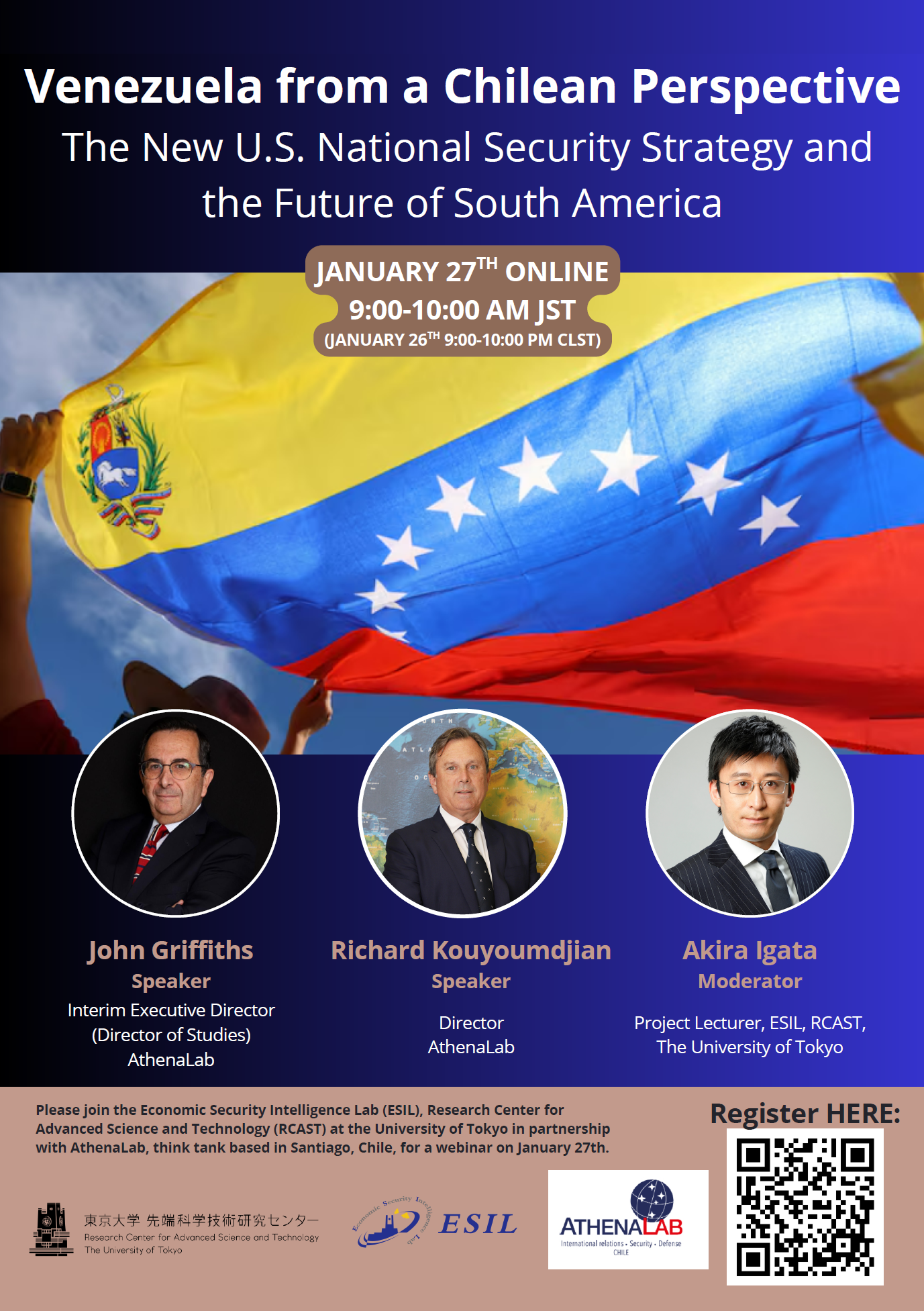
The situation in Venezuela, which has been tense since the end of last year, began moving rapidly in early January 2026. In the early hours of January 3, the United States conducted a large-scale military operation in Venezuela, detaining President Nicolás Maduro and transporting him out of the country. This move has sent shockwaves through the international community, sparking emergency debates in the UN Security Council and intensifying discussions regarding international law and the principles of sovereignty.
These events are beginning to have a profound impact not only on Venezuela’s internal governance and security but also on the regional order of South America. Reactions among South American nations are divided; several countries, including Brazil and Mexico, have expressed strong concerns regarding unilateral military action.
How is this unprecedented intervention perceived within South America itself? This webinar offers a rare opportunity to engage directly with South American perspectives that are often underrepresented in Japanese and international media coverage.
Chile occupies a unique position: it offers an insider’s perspective as a fellow Latin American nation, yet it also experienced a U.S.-linked regime change in the 1970s before successfully navigating democratization and rebuilding its relationship with the U.S. Today, as a stable middle-power democracy maintaining relations with both the U.S. and China, Chile evaluates the actions of great powers from a measured distance. Drawing on Chile’s historical experience and current standing, this webinar will provide a multi-faceted analysis of what the new U.S. strategy for the Western Hemisphere means for South America and the global order.
We will welcome experts from AthenaLab—a Chilean think tank with which RCAST is planning to sign a Memorandum of Understanding (MOU)—to clarify the volatile situation in Venezuela based on the latest developments. We will specifically focus on the new U.S. National Security Strategy (NSS) released at the end of last year. Under the Trump administration, this strategy explicitly prioritizes the "Western Hemisphere" in its foreign and security policy, and the recent actions in Venezuela must be understood within that context. This seminar will examine how the U.S. is redefining South America as a strategic space, as well as the intentions and implications behind this shift.
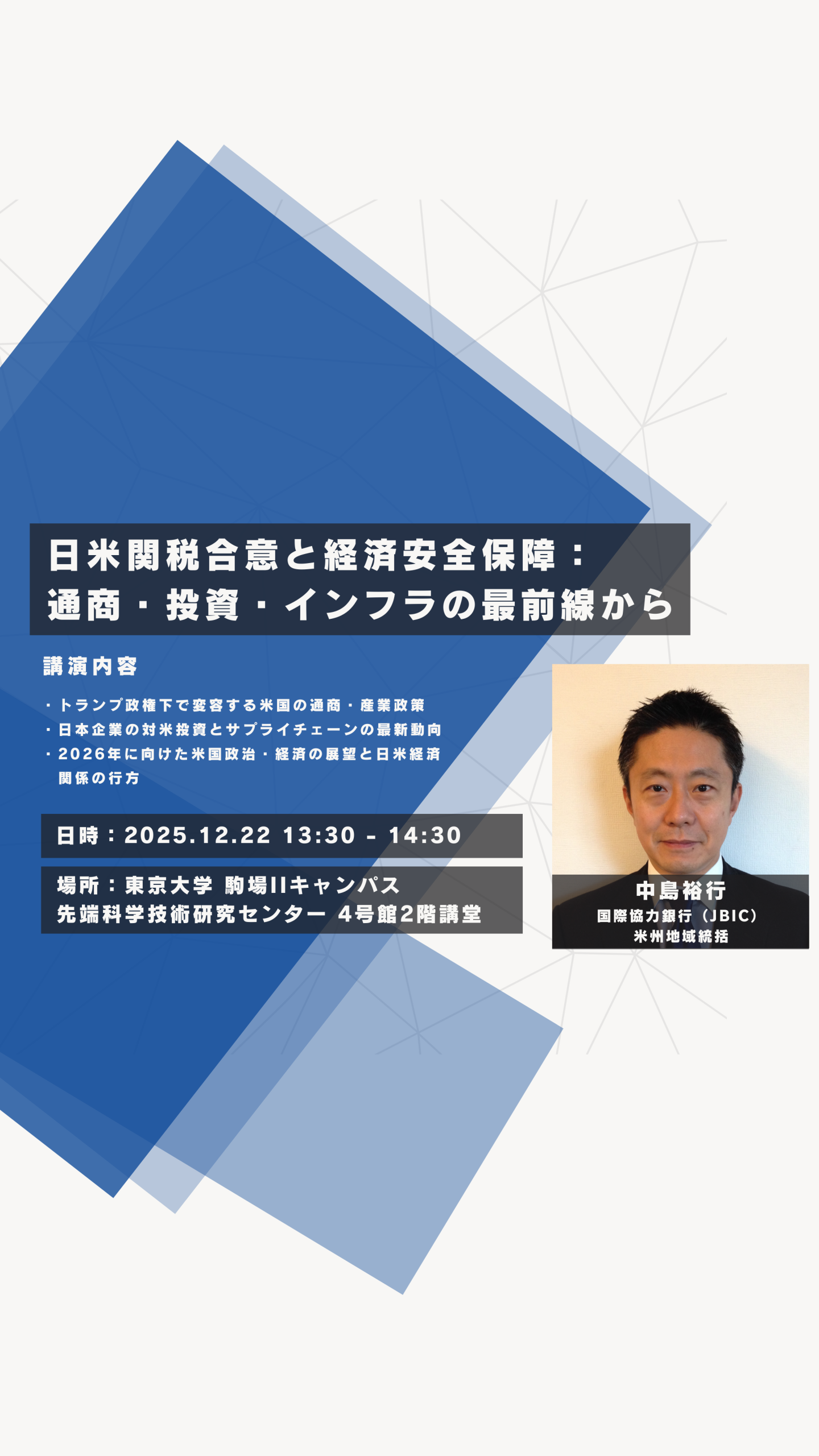
The Economic Security Intelligence Lab (ESIL) at the Research Center for Advanced Science and Technology (RCAST), The University of Tokyo, will host the following public seminar, welcoming Mr. Hiroyuki Nakajima, Head of the Americas Regional Office at the Japan Bank for International Cooperation (JBIC).
The Japan–U.S. Tariff Agreement and Economic Security:
Insights from the Frontlines of Trade, Investment, and Infrastructure
Mr. Nakajima has overseen JBIC’s operations for the United States at its New York office and has been directly engaged at the forefront of major shifts in U.S. trade policy, industrial policy, and external economic strategy under the Trump administration. In particular, he has been deeply involved in analyzing and responding, from both practical and policy perspectives, to how the restructuring of tariff policies and investment and supply chain measures centered on economic security have affected Japanese companies’ strategies toward the U.S. market and the broader Japan–U.S. economic relationship.
In this seminar, Mr. Nakajima will provide an overview of the latest developments and structural changes in Japanese corporate investment in the United States and the associated impacts on supply chains, in light of the Trump administration’s tariff policies. His analysis will draw on the results of JBIC’s Overseas Investment Survey, released earlier this month, which examines Japanese companies’ overseas business activities. He will also discuss the outlook for the U.S. political and economic landscape toward 2026. Domestically, he will consider how divided control of the House and Senate following the midterm elections may affect governance and trade and economic policy. Internationally, with reference to the recently released U.S. National Security Strategy, he will examine how U.S. Asia policy, including its approach toward China, is likely to evolve in coordination with trade, investment, and infrastructure strategies. In addition, where possible, he will offer insights into future directions for Japan–U.S. economic relations, including investment and financial cooperation under the Japan–U.S. tariff agreement.
This seminar will provide a valuable opportunity for researchers, policymakers, and business professionals with interests in Japan–U.S. relations, economic security, trade policy, outward investment, and infrastructure finance to gain a deeper understanding of the intersection between policy and practice. We sincerely look forward to your participation.
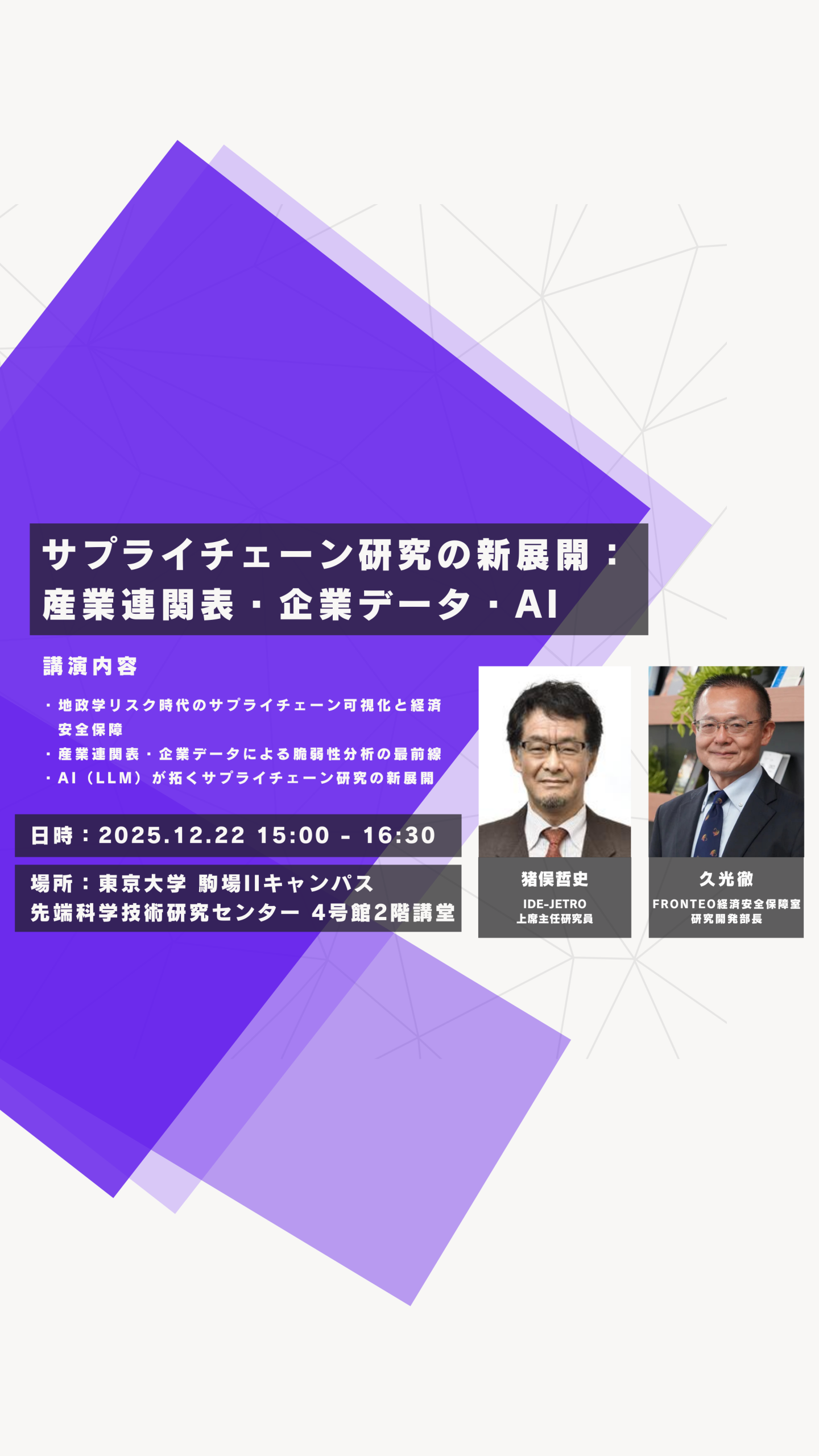
The Economic Security Intelligence Lab (ESIL) at the Research Center for Advanced Science and Technology (RCAST), The University of Tokyo, will host a public seminar co-organized with FRONTEO, Inc. and the Institute of Developing Economies, Japan External Trade Organization (IDE-JETRO).
New Developments in Supply Chain Research:
Input–Output Tables, Firm-Level Data, and AI
In recent years, supply chain visibility and risk management have become indispensable challenges for governments and companies alike. As international geopolitical tensions persist, efforts to diversify supply chains have accelerated not only in advanced technology sectors such as semiconductors, AI, and biotechnology, but also in relation to critical materials and energy. At the same time, sanctions regimes and export control frameworks have been strengthened across countries, and Japanese companies are increasingly required to accurately identify supply chain dependencies and enhance accountability. Against this backdrop, attention to advanced analytical methods from the perspective of economic security has intensified.
Supply chain research has evolved significantly beyond macro-level analysis based on international input–output tables using conventional statistical data. It has expanded toward empirical analysis that leverages actual inter-firm transaction networks, resulting in substantial methodological advancement. In particular, multi-layered approaches are taking shape, including vulnerability assessments using input–output tables, more precise dependency analysis through integration with firm-level data, and the application of large language models (LLMs) to develop new analytical techniques. These innovations have made it possible to capture industrial structures and relationships within global value chains in far greater detail than before.
This seminar will bring together experts working at the forefront of international input–output analysis, inter-firm transaction network analysis, and AI applications to engage in discussion grounded in the latest theory, data, and policy perspectives. In addition to presenting cutting-edge insights on vulnerability analysis using international input–output tables and advanced methodologies that combine firm-level data and AI, the seminar will explore future directions and possibilities for supply chain research from perspectives that cut across policy, industry, and academia.

Institute of Contemporary Asian Studies (ICAS) Temple University Japan and the Economic Security Intelligence Lab (ESIL) at the Research Center for Advanced Science and Technology (RCAST), the University of Tokyo, are pleased to invite you to an online webinar featuring Dr. Laura Murphy, Professor of Human Rights at Sheffield Hallam University and Carr-Ryan Fellow at Harvard University Kennedy School of Government.
Dr. Murphy’s long-standing research on forced labor in the Uyghur region faced unprecedented interference in 2024, which culminated in the Sheffield Hallam University’s decision to discontinue her research in 2025, a development widely reported by major outlets including the BBC and The Guardian. Her case has sparked urgent debate about how external actors may seek to influence or curtail academic inquiry. Building on this and other recent examples, the webinar will explore how shifting international dynamics are creating new forms of transnational pressure on universities, and what these developments mean for academic freedom and institutional autonomy.
The session will examine the broader implications of such pressures for scholars, students, and research institutions, including constraints on transparency, access, governance, and institutional safeguards. As global political uncertainty continues to grow, these issues are becoming increasingly relevant for universities in Japan as well. The event aims to provide researchers, administrators, and students with insights into how higher education institutions can better protect academic freedom and ensure the integrity of their research environments.
In addition to Dr. Murphy, the event will feature opening remarks by Robert Dujarric of ICAS Temple University Japan and will be moderated by Akira Igata, the Research Center for Advanced Science and Technology (RCAST) at the University of Tokyo.
Speaker bio
Laura T. Murphy is Professor of Human Rights and Contemporary Slavery at the Helena Kennedy Centre for International Justice at Sheffield Hallam University (UK). She received the National Endowment for the Humanities Public Scholar Award and was a British Academy Visiting Fellow and a John G. Medlin Jr. Fellow at the National Humanities Center.
She is the author of Freedomville: The Story of a 21st-Century Slave Revolt (Columbia Global Reports, 2021), The New Slave Narrative: The Battle over Representations of Contemporary Slavery (Columbia University Press, 2019), Survivors of Slavery: Modern-Day Slave Narratives (Columbia University Press, 2014), and Metaphor and the Slave Trade in West African Literature (Ohio University Press, 2012). She is also the editor of The Cambridge Companion to Global Literature and Slavery (Cambridge UP, 2022).
Her research team has published a series of reports and evidence briefs about the Chinese government's intertwined systems of internment and forced labor that has been inflicted on the people of the Uyghur Region. The work investigates the international supply chains that have ties to those repressive systems, including those attached to the solar, apparel, chemicals/plastics, automotive, and critical minerals sectors. She has provided expert testimony and evidence on the crisis in the Uyghur Region to the U.S., U.K. and Australian governments and EU leadership. She also provided private briefings to government agencies, advocacy groups, law firms, and others interested in the issue globally.
She has previously conducted research on forced labor in India, Nigeria, Ghana, the United States, and Canada.
She has recently been part of a team that created core competencies for medical professionals addressing human trafficking in healthcare settings with the U.S. Department of Health and Human Services. Her previous research on the intersection of homeless youth and human trafficking in the U.S. and Canada provided a four-pronged, victim-centered community blueprint for how service providers can best assist youth at risk of trafficking, based on interviews with over 600 homeless youth in the U.S. and Canada. She has consulted for the World Health Organization, the U.S. Department of Health and Human Services, the U.S. Office of Victims of Crime, and the National Human Trafficking Training and Technical Assistance Center, as well as other government agencies, workers unions, investor groups, law firms, and advocacy groups.
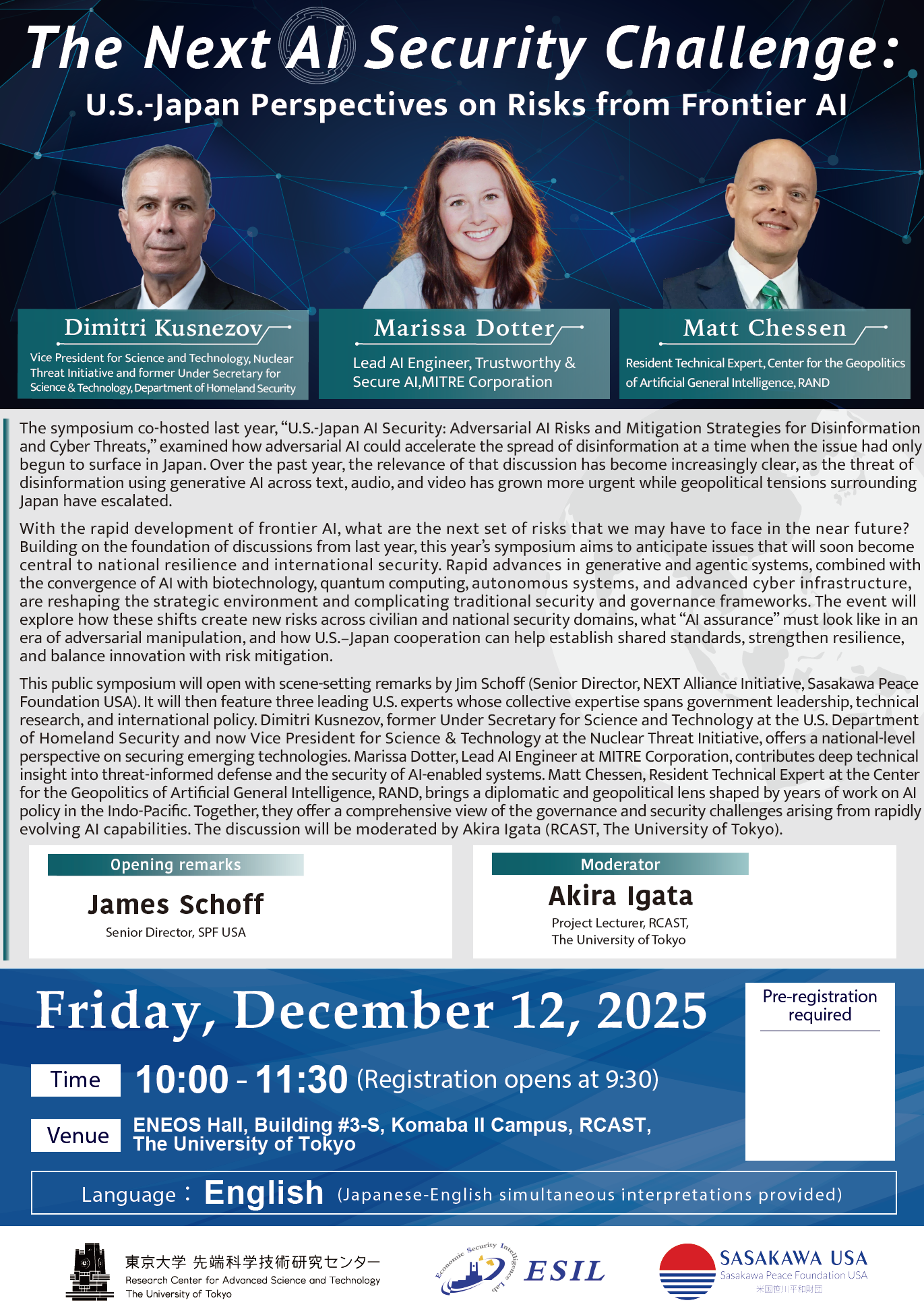
The Economic Security Intelligence Lab (ESIL) at the Research Center for Advanced Science and Technology (RCAST), The University of Tokyo, and SPF USA is honored to co-host for a public symposium titled:
The Next AI Security Challenge:
U.S.-Japan Perspectives on Risks from Frontier AI
The symposium co-hosted last year, “U.S.-Japan AI Security: Adversarial AI Risks and Mitigation Strategies for Disinformation and Cyber Threats,” examined how adversarial AI could accelerate the spread of disinformation at a time when the issue had only begun to surface in Japan. Over the past year, the relevance of that discussion has become increasingly clear, as the threat of disinformation using generative AI across text, audio, and video has grown more urgent while geopolitical tensions surrounding Japan have escalated.
With the rapid development of frontier AI, what are the next set of risks that we may have to face in the near future? Building on the foundation of discussions from last year, this year’s symposium aims to anticipate issues that will soon become central to national resilience and international security. Rapid advances in generative and agentic systems, combined with the convergence of AI with biotechnology, quantum computing, autonomous systems, and advanced cyber infrastructure, are reshaping the strategic environment and complicating traditional security and governance frameworks. The event will explore how these shifts create new risks across civilian and national security domains, what “AI assurance” must look like in an era of adversarial manipulation, and how U.S.–Japan cooperation can help establish shared standards, strengthen resilience, and balance innovation with risk mitigation.
This public symposium will open with scene-setting remarks by Jim Schoff (Senior Director, NEXT Alliance Initiative, Sasakawa Peace Foundation USA). It will then feature three leading U.S. experts whose collective expertise spans government leadership, technical research, and international policy. Dimitri Kusnezov, former Under Secretary for Science and Technology at the U.S. Department of Homeland Security and now Vice President for Science & Technology at the Nuclear Threat Initiative, offers a national-level perspective on securing emerging technologies. Marissa Dotter, Lead AI Engineer at MITRE Corporation, contributes deep technical insight into threat-informed defense and the security of AI-enabled systems. Matt Chessen, Resident Technical Expert at the Center on the Geopolitics of Artificial General Intelligence, brings a diplomatic and geopolitical lens shaped by years of work on AI policy in the Indo-Pacific. Together, they offer a comprehensive view of the governance and security challenges arising from rapidly evolving AI capabilities. The discussion will be moderated by Akira Igata (RCAST, The University of Tokyo).
Mailing List
The earliest information about the latest event will be delivered.
Please register from the button below.
If you have any requirements, please contact us using the contact form.