Events
"Let's Look Inside UT's Labs!" is an annual event that has been held since 2012, during which high school students from all over Japan and the world get a glimpse of what it's like inside the University of Tokyo. This year, our Igata Lab is joining this program! Wouldn't you like to take a look at the researchers and students who tackle the (currently very topical) issue of Economic Security in their natural habitats?
Nowadays, some states are not only increasing their military power but also refining their tactics through economic and informational policies in response to geopolitical tensions. It is becoming increasingly important to secure supply chains of semiconductors, AI and biotechnologies and increase their global competitiveness. Furthermore, gathering intelligence despite the potential for disinformation and influence operations by generative AI is also of importance. In this event, we will host a lecture covering the fundamentals of economic security and an analysis of some states' recent behaviours. We will also showcase student activities and conclude the sessions with an all inclusive Q&A and discussion.
We will host two in-person sessions on March 26 and two on-line sessions on March 27.
(*Please note that all four sessions will be the same content.)
On March 26 (Thursday), students will have the opportunity to visit the Research Center for Advanced Science and Technology in Komaba Campus II, and directly talk to Project Lecturer Igata and a few members of the Economic Security Intelligence lab.
On March 27 (Friday), as the entire program will be carried out online, students living far away will also have a chance to join.
We look forward to receiving your active participation!
-
Date
[In-person] March 26, 2026 (Thursday): (1) 10:15~11:15、(2) 13:15~14:15
[Online] March 27, 2026 (Friday): (1) 13:40~14:40、(2) 14:50-15:50 -
Place
March 26, 2026 (Thursday): Komaba II Campus
March 27, 2026 (Friday): Online - Fee Free of charge (Participants are responsible for their own travel, accommodation, and other expenses.)
- Speakers Akira Igata (Project Lecturer, RCAST, The University of Tokyo) and other members of the lab
- Language Mainly Japanese

The Economic Security Intelligence Lab (ESIL) at Research Center for Advanced Science and Technology (RCAST) at The University of Tokyo is pleased to host Research Institute for Democracy, Society and Emerging Technology (DSET), a think tank established by the Government of Taiwan, for the “Japan–Taiwan Economic Security Dialogue.”
The dialogue will provide a multidisciplinary discussion on economic and research security issues concerning Taiwan and Japan.
Key Discussion Topics:
Responding to Strategic Uncertainty: Japan–Taiwan Coordination in the Trump 2.0 Era
Examining the impact of the Trump administration’s tariff policies on Taiwan’s semiconductor industry.
Balancing Innovation and Security: Comparative Perspectives on Research Security
Invisible Infrastructure, Visible Risks: Submarine Cables and Economic Resilience
Topics include Japan’s designation of submarine cables as “critical infrastructure” and the establishment of dedicated funding mechanisms.

The Economic Security Intelligence Lab (ESIL) at the Research Center for Advanced Science and Technology (RCAST), The University of Tokyo, is pleased to host Albert Zhang from OpenAI’s Intelligence and Research team for a public seminar. He will discuss how generative AI, including ChatGPT, is being used to spread misinformation and conduct influence operations. The seminar will feature active discussions on preventing the misuse of AI and fostering public-private collaboration.
Key topics covered in the seminar will include:
・A case in which a long Spanish-language article disparaging the United States was generated using AI and published as-is in mainstream Latin American media.
・Instances where Iranian intelligence personnel used generative AI to create tweets and articles, which were then posted on third-party platforms.
・Examples of AI-generated comments criticizing Chinese pro-democracy activist Cai Xia, which were disseminated on social media.
The seminar will also include a Q&A session focusing on preventing the misuse of AI, the sharing of data between public and private sectors, and perspectives on international cooperation in this area.
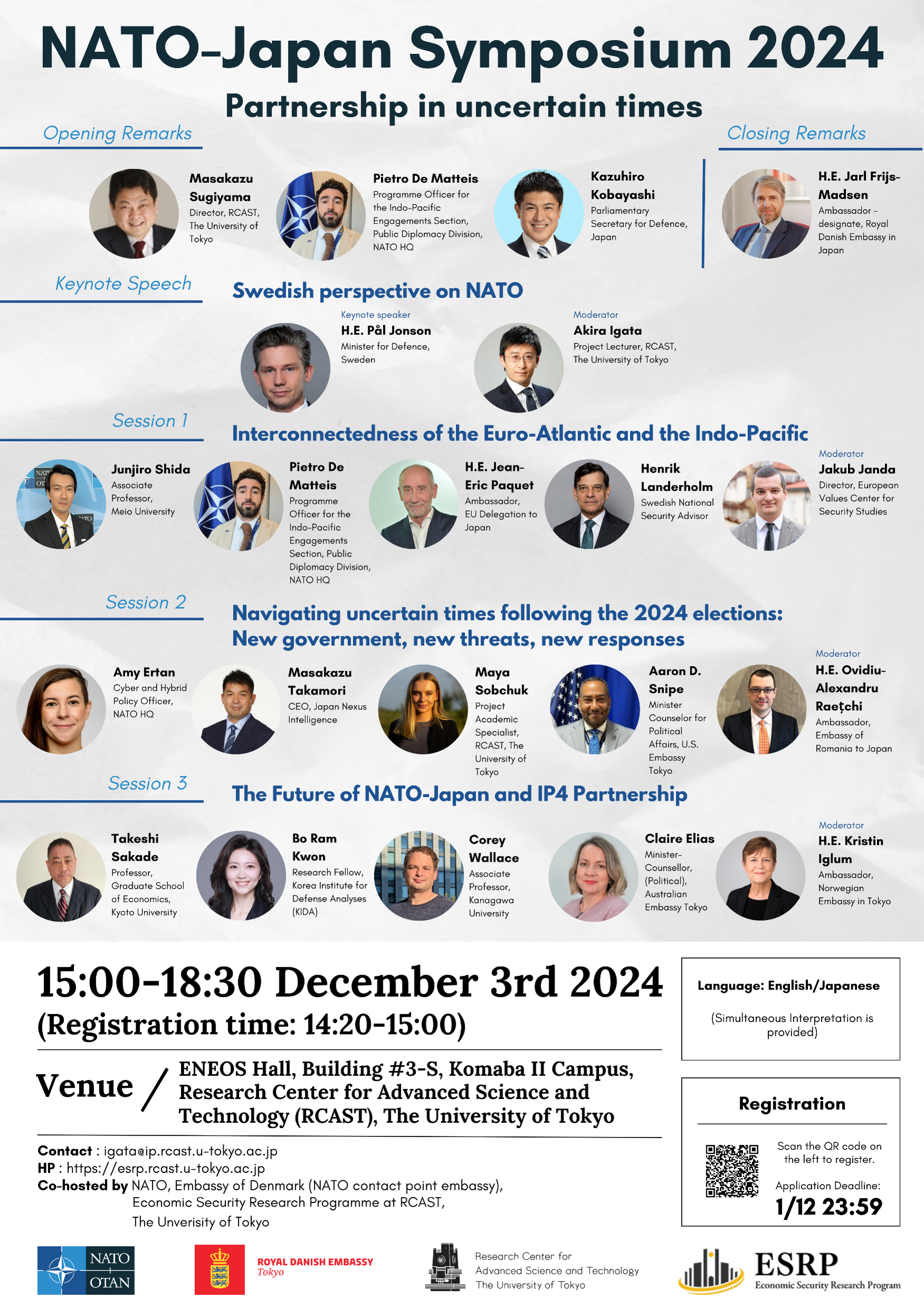
Research Center for Advanced Science and Technology (RCAST) at The University of Tokyo, along with the NATO HQ and the Royal Danish Embassy Tokyo (NATO Contact Point Embassy), will co-host the "NATO-Japan Symposium 2024: Partnership in Uncertain Times."
Following the "NATO-Japan Symposium 2023: Emerging Security Challenges," we will once again convene experts from around the world to RCAST, The University of Tokyo to discuss how partner countries can collaborate with each other in the era where uncertainty reigns.
This year, we have the privilege of welcoming the Swedish Defense Minister to make a keynote speech. This will be followed by a discussion among NATO HQ experts, numerous Ambassadors (EU, Norway, Denmark, Romania), and Japan's Parliamentary Vice Minister of Defense, among others.
We will focus on 3 topics during the discussions. (1) Interconnectedness of the Euro-Atlantic and the Indo-Pacific; (2) Navigating uncertain times following the 2024 elections; New government, new threats, new responses; and (3) The Future of NATO-Japan and IP4 Partnership.

Research Center for Advanced Science and Technology (RCAST), The University of Tokyo and The Swedish National China Centre (NKK) and The Asia Programme at The Swedish Institute of International Affairs (UI) will co-host a symposium, with a backing from the Embassy of Sweden in Tokyo, titled “Japan-Sweden Relationship in a shifting era: Exploring common interests and opportunities following the 2024 elections.”
This symposium will bring together Swedish and Japanese experts on security and economic issues to discuss: (1) How Sweden and Japan perceives the impact of various elections that have taken place in 2024 and the increasing coordination between China and Russia; (2) How Sweden and Japan are responding to the rise of China; and (3) Comparative approaches towards de-risking between Europe and Japan
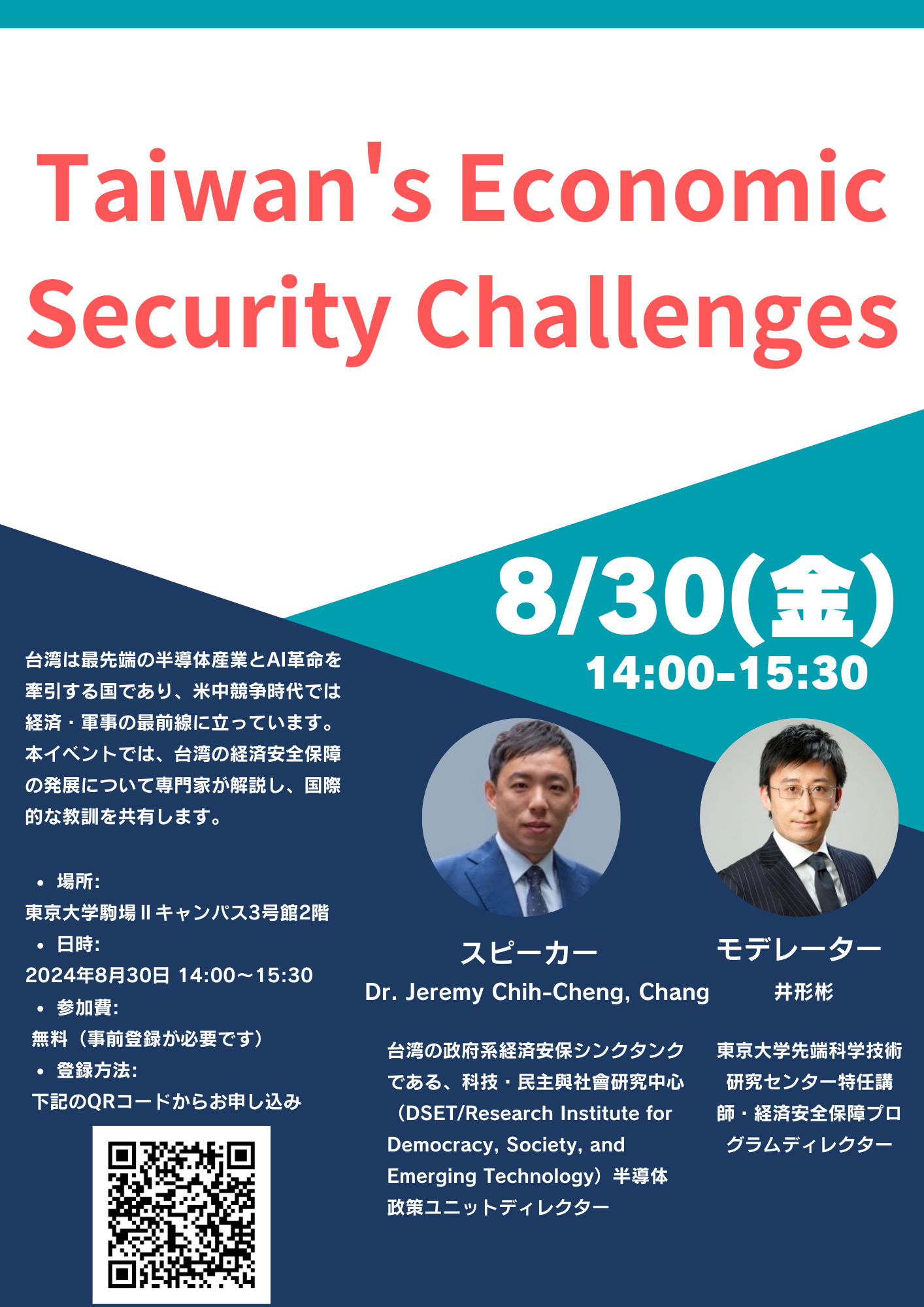
Taiwan has become a global powerhouse in cutting-edge semiconductor manufacturing and a driving force in the next generation of AI revolution. However, due to its dynamic economic relationship and tense military relations with China, the high-tech island nation has found itself at the forefront of potential global conflict zones since the escalation of the techno-geopolitical era of comprehensive US-China competition.
As economic security becomes an increasingly important element of national security, Taiwan’s experience offers important insights into how the People’s Republic of China (PRC) has advanced its technological power. At the event, Dr. Jeremy Chih Cheng Chang, a research fellow and Director of Semiconductor Policy at DEST, a new launched public think tank in Taiwan, will explain the evolution of Taiwan's economic security framework, exploring historical perspectives and regulatory insights, and discussed lessons learned for international allies.

Today, there is growing attention on societal impacts of the rapid development of Artificial Intelligence. While the utilization of cutting-edge AI technology offers various advantages, the development and use of "adversarial AI," or AI with malicious intent or attacks against AI, has emerged as a serious economic security risk for nations around the world.
Against this backdrop, RCAST, the University of Tokyo and the Sasakawa Peace Foundation USA will co-host a symposium titled "US-Japan AI Security: Adversarial AI Risks and Mitigation Strategies for Disinformation and Cyber Threats".
The symposium will feature speakers from the U.S. government in charge of developing policies to promote and regulate AI technology development, as well as researchers from Lawrence Livermore National Laboratory (LLNL), Oak Ridge National Laboratory (ORNL), and Pacific Northwest National Laboratory (PNNL), leading national research institutes for AI research in the United States. They will introduce cutting-edge AI technology developments in the U.S. and explore risks and opportunities these technologies will bring to our society. In particular, we will discuss how to deal with AI-enabled disinformation and cyberattacks, ideal promotion and regulatory means for the government, and the future of Japan-US cooperation on AI related issues.
The event report is here.

Economy security has recently become a central issue of concern for governments and businesses around the world. Various governments have created new strategies, institutions, and tools to address these new challenges. However, the private sector involvement is critical in the effective implementation of these government policies.
Under these circumstances, RCAST, The University of Tokyo and Law and Geoeconomics will convene a symposium titled _State-Firm Relations and Economic Security: International Comparisons of U.S., China, EU, Australia, and South America_, with the support of Helsinki Geoeconomics Week and the Embassy of Finland.
This symposium will bring together experts on economic security from the U.S., China, EU, and South America to compare how state-firm relations differ in regions around the world, especially given the rise of economic security risks and opportunities. This will allow for the sharing of best practices as well as identifying potential areas of cooperation among countries.

Research Center for Advanced Science and Technology (RCAST), The University of Tokyo and the Institute of Contemporary Asian Studies (ICAS) at Temple University, Japan Campus (TUJ), co-host a brown bag lunch seminar featuring Irina Novakova, the Head of the Euro-Atlantic Disaster Response Coordination Centre (EADRCC), NATO HQ, with the support of Royal Danish Embassy, Japan.
EADRCC is NATO's principal mechanism to respond to civil emergencies. Ms. Novakova will first give a speech addressing NATO's work on cooperative security, which covers cooperation with Japan and working to support partners build up their resilience and security. She'll also focus on examples from support for Ukraine, cooperation on disaster response, and support for building partners' defence capacities.
Her introductory remarks will be followed by comments from two expert panelists. Robert Dujarric (ICAS, TUJ) will give us a historical perspective, while Maya Sobchuk (RCAST, The University of Tokyo) will touch upon the issue of strategic communication and disinformation in disaster responses. Akira Igata will be the moderator, while also commenting from the angle of economic security policies. This will be followed by a moderated discussion and Q&A with the audience.

Economic security has become one of the top priority areas for policy-makers in both Japan and the United States. Furthermore, there is now a general consensus between the two countries regarding the perception of shared economic security risks as well as in areas where cooperation among allies and partners in addressing these risks would be mutually beneficial.
However, there are areas of specific policy coordination that require further discussion to promote an effective U.S.-Japan economic security cooperation. The development and protection of critical and emerging technologies is a top concern among them, where coordination and cooperation in using numerous policy tools would be effective in furthering the national interests of both countries. These include: subsidies; joint R&D; visa regulations; export controls; inbound and outbound investment screening mechanisms; and cyber security.
In order to discuss these issues, RCAST, The University of Tokyo and Sasakawa Peace Foundation USA will co-host a symposium titled "Japan-U.S. Economic Security Policy Coordination: Development and Protection of Critical and Emerging Technologies" on March 4th. This symposium will feature speakers from the U.S. who have been at the forefront of practice and research in these issues in the government, legal practice, academia, think tank, and business sectors.

The relationship between Japan and Central and Eastern Europe (CEE) has been one of the underexplored areas in international politics. However, the threat perception and foreign policy of the CEE states are changing due to the dramatic shift in the global security environment. This change has opened up new possibilities for cooperation between Japan and CEE countries.
We are proud to invite three speakers from the European Values Center for Security Policy (EVC), a Prague-based think tank and the only European think tank with a permanent presence in Taiwan. The three speakers will discuss "Economic Security," "Disinformation," and "Taiwan" from the perspective of the CEE countries. This will be followed by a moderated discussion and a Q&A with the audience.
Mailing List
The earliest information about the latest event will be delivered.
Please register from the button below.
If you have any requirements, please contact us using the contact form.